Biology
Jobs for Biology
Having a biology degree and open new job opportunities such as:
- Pharmacologist (medicine)
- Medical Scientist (human anatomy and medical studies)
- Environmental scientist (studies nature)
- Bioinformatics scientist
Most jobs involving a Biology degree are in the medical or scientific field, such as doctors, pharmacists, scientists, and more. This is because biology is originally the study of living organisms and its activities.
What is Biology About?
Biology is the scientific study of physical living organisms on their anatomy, evolution, growth, reproduction, function, purpose, and basically the study of life.
Biology 9 focuses on asexual reproduction, as in mitosis, and sexual reproduction, as in meiosis and human sexual reproduction. Biology 9 is the subject of learning about cells and how they reproduce.
The Cell Cycle

What Comes Out of Studying Biology
After biology, students will learn how to identify different cells, identify anatomy, and know the process of reproduction. This can also help students know how cells work, such as their forms and activities. Studying biology helps the student improve their memorization skills, anatomy knowledge, and overall education.
Post-Secondary Biology
Medical careers such as doctors, nurses, and pharmacologists require a biology degree. Biology in higher grades teach about human anatomy, and this knowledge can even save a student's life, as when they get hurt they know which part to tend.
To understand the complications of biology, we must first understand the cell cycle and the way it functions.
The four main stages of the cell cycle are:
1. G1 (Gap 1) phase
This is the phase where the cell functions normally while preparing for the next stage, which consists of DNA replication.
2. S (Synthesis) phase
The second phase is where the DNA of the cell gets replicated into two daughter chromatids (duplicates with the same DNA)
3. G2 (Gap 2) phase
The cell still functions and grows to prepare for the mitosis process later on
The first 3 stages are known as the interphase. The interphase is the phase of preparation for mitosis (grow and
4. M (Mitotic) phase
This last phase is known officially as "Mitosis". This is the process of separating the already duplicated chromosomes (daughter chromatids) into two identical sets of it. This is divided in five stages, which we'll get into next.


This is mitosis
Asexual Reproduction - Mitosis
Mitosis is the process of cell division by copying its own chromosome that results in two separate yet identical cells. This process's function is to produce an identical nuclei to prepare for cell division. The process usually follows the process of producing two identical daughter cells that have identical genomes (DNA - genetic instruction - what the cells are). Mitosis is usually found in eukaryotic cells (germ cells).
Mitosis consists of five different stages:
1. Prophase (early)
The prophase is the very first stage of mitosis, which is the stage of preparation for cell division. In early prophase, the chromosomes begin to slowly condense (chromosomes are supposed to get pulled apart later on, and this makes it easier to do so) and the mitotic spindle (composed structure of microtubules - the format is similar to the shape of a football) begins to form. It's kind of like the cell's bones, similar to a "skeleton". The purpose of the mitotic spindle is so the chromosomes can become organized and are able to get moved around during the mitotic process. During the prophase, the nucleolus is also broken down and removed (dissolved and rearranged into the two daughter cells - now it cannot be seen).
4. Anaphase
The fourth stage is where the sister chromatids begin the separation process physically. The "glue" made out of protein becomes broken down, and the sister chromatids are started to get pulled towards the sides of the cell, away from each other. Each sister chromatid is now its own chromosome, since they are no longer attached to each other. This process relies on motor proteins, which are "machines" that are able to walk on the tracks of the microtubules and carry a cargo (transmembrane proteins - other chromosomes or microtubules).

Visual representation of mitosis

These are cells going through mitosis under a microscope
2. Prometaphase (late)
Prometaphase is basically late prophase. In this phase, the chromosomes become fully condensed, following up from the last phase. This results in the chromosomes becoming extremely compact, revealing that it is ready for the mitosis. Another element that breaks dow other than the nucleolus is the nuclear envelope (a double membrane that surrounds the nucleus with eukaryotic cells with separates it from the cytoplasm). This breakdown releases the chromosomes inside the cell. Also, the mitotic spindle continues to grow, and some chromosomes even get captured (hooked onto the mitotic spindle). The way this happens is that the microtubules are able to bind to the chromosomes at a part of the cell called the kinetochore, which is a section of protein found at the middle of each sister chromatids (the centromeres). Once the microtubules bind with the chromosomes, they're now known as kinetochore microtubules. The microtubules that did not bind are able to bind with the other side's microtubules and extend themselves. This forms an aster, which is a structure.
5. Telophase and cytokinesis
a. This is the last phase of mitosis. At this point, the cell is almost done separating. Because of this, it starts to rebuild its normal structures the same times as cytokinesis (cell contents division) take place in the cell. The mitotic spindle that was once working hard is broken down into small building blocks for the cell, two new nuclei form. Two are formed so each set of chromosomes are able to have one. Other things are starting to reappear, and those are nuclear membranes and the nucleoli. Chromosomes are beginning to decondense (become "harder") and return to their original structure and form.
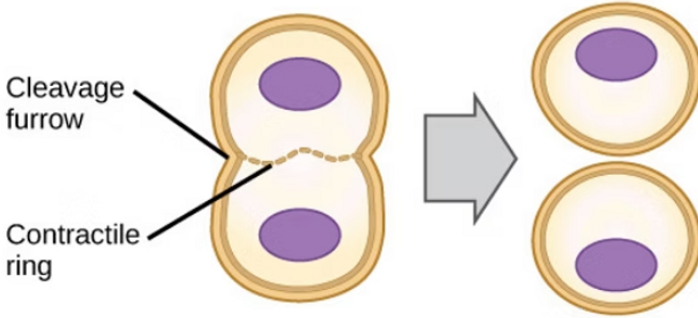
b. cytokinesis is the physical act of separating (dividing) the cell into two parts. This phase sometimes overlaps with the stages of mitosis, either in anaphase of telophase, but always finishes after telophase has ended. Cytokinesis pinches the cells into two as if its a drawstring. The "drawstring" is filled with filaments made from actin (a type of protein). The crease from the pinch is called the cleavage furrow. This only happens in animal cells, because plant cells are too stiff since they have a cell wall outside of the cell membrane. Instead, the cell plate in the plant cell, becoming a wall and separating the two daughter cells down the middle of the cell.
3. Metaphase
This is the third phase of mitosis, where the chromosomes line up in the middle, known as the metaphase plate (it's not a physical section in the cell, just a name people use to call it for simpler explanations). This stage is also where the chromosome's two kinetochore's are attached to the microtubules from the spindle poles (opposite ones). Before moving onto the next phase (anaphase), the cell will have a checkpoint. The checking requirements are that the chromosomes are all lined up at the metaphase plate and the kinetochores are all attached onto the microtubules. This checkpoint is known as the "spindle checkpoint". Its function is to ensure that the sister chromatids are able to split properly in the further process. Cells cannot move onto the next step until the problem is resolved.

Visual representation of mitosis

This is a cell under the process of mitosis (cytokinesis)
Afterwards
After this process, two new cells are formed. Each cell has the same set of chromosomes exactly the same to the mother cell. Now the separated cells can start to live on their own. Some cells may undergo the mitosis process again to carry on/repeat the cycle.